Our Impact

We help transform the lives of marginalized youth, while also expanding our impact and influence by sharing knowledge and creating change in the child welfare system.

youth stories
Transform the lives of marginalized youth. Stepstones Staff

By the Numbers

StepStones has grown this past year, increasing the number of youth we support, and continuing to work to make an even greater impact:

808

youth were supported across all of StepStones’ programs


275

youth were supported with full wrap-around supports in the Building Connections Program, including educational supports, homelessness prevention, and mental health counselling


94%

of youth in our Building Connections Program have either graduated or are attending high school. In Ontario, only 48% of youth from the foster care system graduate from high school compared to 89% of the general population


92%

of youth in our Building Connections Program are in safe housing. In Ontario, 58% of youth experiencing homelessness have been involved with the child welfare system


83%

of youth in our Building Connections Program have stable mental health. Only 24% of youth at intake identified as having stable mental health


562

housing and mental health subsidies were distributed to youth


78

workshops and events were facilitated


8820

hours of therapy, counselling and service navigation were offered


1103

emergency food and care packages provided


522

volunteers making a difference in the lives of youth


Our Impact in 2025

In 2025, StepStones evaluated new data, solidified new learnings, and helped young people achieve great things.

At StepStones for Youth, we go beyond meeting immediate needs—our programs tackle the root causes of instability so young people from the child protection system can build strong, healthy futures with people who care about them. Here is what makes StepStones’ unique and impactful:

  • Nationally Recognized: Last year, StepStones was ranked among the Top 5 Charities in Canada by Charity Intelligence
  • Award-Winning Innovation: Our Building Connections program was named the most innovative homelessness prevention program by the Canadian Alliance to End Homelessness, with proven success in improving housing stability and educational outcomes for youth from foster care.
  • One of Few: We are one of only a handful of organizations in Canada focused exclusively on supporting young people from foster care

Research, analysis, and evaluation are critical to understanding how our programs directly improve the trajectories of young people involved in the child welfare system. To maximize impact for youth in our target population, we have learned that it is vital to create comprehensive research and evaluation processes to continually monitor and assess progress. This allows us to focus on achieving intended impacts for better long-term outcomes.

Our referral forms capture data from both the young person being referred as well as what the referring source believes to be important for the young person. StepStones Connection Coordinators, our front-line workers, conduct interviews with youth at intake to our program and at six month intervals during the tenure of their involvement to collect demographic information and track the most current status related to education, employment, housing, mental health, skill development, connections, and sense of community and belonging.

Each instance of evaluation allows us to reflect on progress made as well as areas for individual service modification or improvement. We consistently review research and data collected on identity demographics and outcomes and compare this data to ensure that youth in different demographics report similar results. Our Program Supervisors review each instance of a report, connect with Connections Coordinators about areas of concern or success, and provide guidance.

Our measurement criteria are defined by the voices, experiences, and ideas of the young people we serve. We seek their guidance in the design and revisions of our evaluation processes including the language used in our surveys; the modes by which we track their progress; transparency in our ongoing consultations with their Children’s Aid Society workers, foster parents, and mentors for holistic assessments; and the methods by which we obtain information from and about them. We ask young people themselves for feedback by providing youth with user experience surveys about every aspect of our program that they are involved in and compare this feedback with our data to increase our understanding of our impact.

At StepStones for Youth, we believe every young person deserves the chance to thrive.

Our vision is simple: all youth should have access to the tools they need to graduate high school, go on to post-secondary education or meaningful work, find stable housing, get the mental health support they need, and feel a strong sense of belonging.

But the reality is, youth aging out of foster care face serious barriers. Compared to their peers, they’re more likely to experience poverty, lower graduation rates, unstable employment, homelessness, poor mental health, and isolation.

Our programs are designed to change that. Through wrap-around support and regular check-ins, we track each young person’s progress and use what we learn to make our programs even stronger. We collect data when youth join us and every six months after, helping us understand what’s working—and where we need to do more.

Here are a few changes we’ve made recently based on what youth have told us and what the data shows:


Housing Grants for School Success – 2020

Youth from foster care often have the same dreams of college or university as their peers—but face far more obstacles getting there. While StepStones once offered education bursaries, we found that financial support had no positive impact on whether or not a youth went to school.

Our evaluations showed that stable housing is what truly makes the difference. Without it, youth often drop out of school to pay rent, putting them at risk of homelessness, trafficking, and long-term instability.

That’s why we shifted our focus from tuition support to student housing grants—and it’s working. We continue to offer these housing subsidies to help youth stay in school and build a secure future.


The Importance of Connection – 2021

Our experience has shown that even when young people in the child welfare system receive education, housing, and mental health support, it’s not enough on its own. Without strong, long-term relationships with caring adults—like extended family, mentors, and community allies—many still struggle to move forward.

At StepStones, we take a relational approach. Our programs are designed to help youth build lasting connections with people who reflect their identities and lived experiences. These relationships are key to healing, belonging, and long-term success.

We also know that many youth from foster care are disconnected from their cultural roots. That’s why we support them in reconnecting with their communities, reclaiming their identities, and finding adults they can trust—not just for a program, but for life.

The gap we fill is clear: reducing isolation and disconnection by helping youth build real relationships with people who are already in their lives—or want to be—but need support to show up in meaningful ways.


Numbers of Connections for Youth – 2022

When we first launched our connections-based programming, we drew from evidence-based models—like one that showed over 100 potential adult connections could be identified for a child within 30 days of entering care. But we quickly learned this didn’t reflect the realities of older youth in foster or group homes.

Many of the young people we work with have experienced trauma, instability, and years of institutional care. Reconnecting with extended family or building new relationships isn’t easy—and pushing for 100 connections often felt overwhelming and unhelpful.

So, we shifted our approach. Instead of focusing on large numbers, we focused on building meaningful relationships. We reduced our goals to 50 connections and a circle of support of five trusted adults (instead of eight). This allowed us to go deeper, not just wider—and the results have been powerful.

We also know the work doesn’t stop once a youth is matched with a mentor or family member. Building trust and a strong support network takes time, and we continue walking alongside youth as they expand those circles.


Group vs Individual Work – 2023

When we started doing connections-based work, we used group retreats to help youth build trust and connect with peers early on. But we learned that group settings don’t always feel safe for sharing personal histories—especially for youth who’ve experienced trauma.

That’s why we shifted to a one-on-one model. Our Connection Coordinators now work directly with each young person, helping them explore their past and map out important relationships in a private, supportive space. This approach builds trust, creates stronger connections, and leads to better long-term outcomes.

We still run group retreats—and while they’re not used for personal history work, they’re a powerful way to boost confidence, build camaraderie, and help youth feel part of a supportive community.


Stable Housing in a Rental Crisis – 2024

At StepStones, we know that stable, affordable housing is key for youth to succeed in school, improve their mental health, and build a better future. That’s why we prioritize long-term housing support for young people at high risk of homelessness.

Over the past year, fewer subsidized housing options and a tough rental market in Toronto (an 8% rent increase for a one bedroom apartment in 2024 vs 2023) made it harder for youth to secure safe, stable homes. Multiple partner agencies that we relied on for support have lost funding resulting in changes in eligibility for housing support. In some cases, youth are required to have been living in a shelter for 6 months before becoming eligible for support. In response, we expanded our housing subsidy program by offering 505 portable housing grants—a grant that allows youth to continue to receive support regardless of where they choose to live. This represented a 91% increase in subsidies distributed from the previous year (505 in 2024 vs 265 in 2023). Next year, we’re expanding access to our portal, partnering with organizations across Canada to help reduce youth homelessness from coast to coast.


Consistency for a Strong Sense of Belonging – 2024

Youth involved in child welfare often grow up with loss, instability, and disconnection from family and community. At StepStones, we know that rebuilding trust and identity takes time—and consistent, welcoming spaces.

That’s why in 2024 we increased our hours of engagement programming by 18% compared to 2023 and 53% from 2022. We began hosting weekly community dinners every Tuesday. These evenings offer more than just a home-cooked meal. They’re a chance for youth to connect with caring adults, discover StepStones programs, and spend time with peers in a safe, supportive space.

There’s always food, conversation, arts activities, and even door prizes. Youth tell us it feels “like something a family would do”—and that sense of routine and community helps build confidence, self-worth, and connection.


Increasing Food Security – 2024

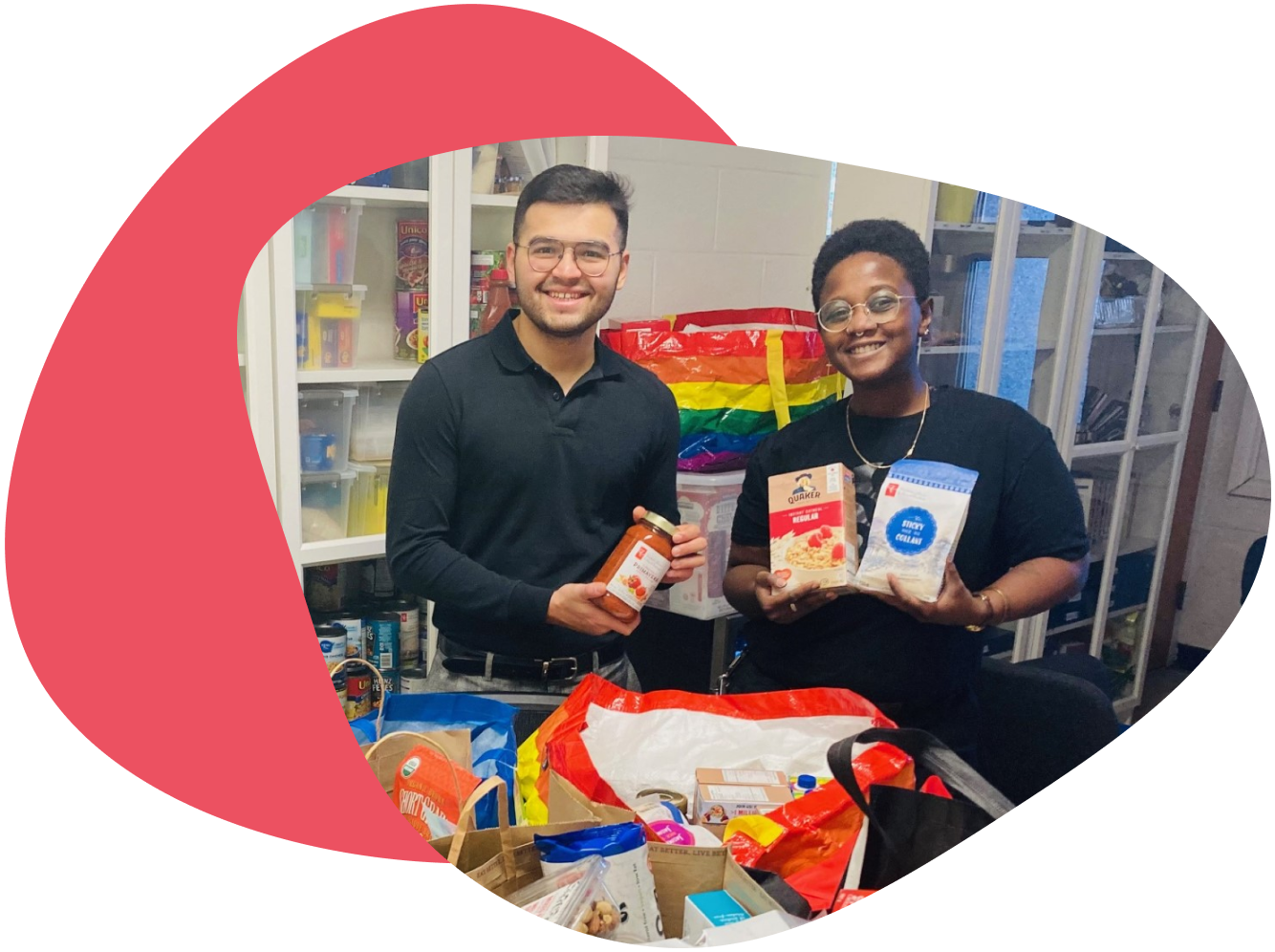
Rising food costs (a 29.6% increase from 2019 to 2024) make it tough for youth leaving foster care to meet basic needs like food and safety. StepStones helps by offering an emergency food pantry stocked with donations, weekly community dinners with take-home meals, and grocery gift cards distributed to youth for fresh food. In 2024, we had a 256% increase in the number of emergency food and care packages distributed (976 in 2024 vs 274 in 2023).

In 2024, we also ran 5 cooking workshops with professional chefs to build skills and confidence in the kitchen. This year, we’ll host community food events celebrating the winter holidays, Black History Month, and more.

Our Connection Coordinators use these programs to connect with youth, talk about nutrition, and build trusting relationships.

Increased Need for our Service – 2024

This past year, the demand for StepStones’ programs grew higher than ever. In order to maintain the same quality of service for youth in our program, for the first time in our history, we had to create a waitlist of over 150 youth. The rising cost of living, increased mental health challenges in youth, and the closure of other non-profits serving this population, have all contributed to more youth reaching out for support as they transition out of foster care.

In response, we offered alternative services like subsidies, service navigation, invitations to our Engagement Program events, and referrals to other organizations. Simultaneously, we are expanding our capacity by growing our team from 11 to 14 Connection Coordinators. We will also be expanding our program model to partner organizations to new jurisdictions to reach more youth and have increased our targets for fundraising, so our program has the resources and staff to meet this growing need. This investment means more Connection Coordinators, more direct support, and faster access to services for youth who need them most. As of early 2025, we have begun to intake youth from our waitlist with the goal of opening up referrals to our program in late 2025.

By scaling our staff and programs, we’re ensuring that no young person is left behind—and that every youth who turns to StepStones can find the stability and support they deserve.

Online Granting Portal – 2025

In 2025, we learned that introducing a new online granting system requires more than simply building and launching the technology. While our Granting Portal has improved efficiency and strengthened the reliability of our reporting, the project was more complex and required more capacity than we initially anticipated. As the system evolved, changes to Microsoft’s platform, the complexity of its features, and the need to monitor applications for accuracy meant that ongoing technical support and staff training were necessary.

We also learned that moving a process online does not automatically make it simpler. Some applications now require additional staff review, troubleshooting, and follow-up with external agencies, particularly when applicants are unsure how to complete a section or when information needs to be corrected. We are using these lessons to strengthen our systems, work with pro bono IT consultants, provide additional support and training to staff and partners, and ensure the Portal continues to work effectively for the youth and agencies who rely on it.

Youth Subsidies Policies – 2025

In 2025, we learned that providing financial support is only part of the challenge of making grants accessible to youth. Some young people who would benefit from a subsidy were unable to receive it because of barriers outside their control, such as landlords who could not accept certain payment methods or the difficulty of obtaining required documents within short submission timelines. In some cases, delays in obtaining documents meant that youth missed a regular submission deadline even though they were experiencing a genuine financial need.

These experiences showed us that a grant process can unintentionally create barriers for the very youth it is intended to support. Throughout 2025, our Connection Coordinators worked closely with youth and landlords to resolve these issues and help applications move forward. At the same time, we recognized that the process itself needs to evolve. In 2026, we are re-examining how we administer subsidies, using what we learned in 2025 to make the process more responsive, accessible, and efficient for youth while maintaining appropriate accountability for the funds we provide.
 

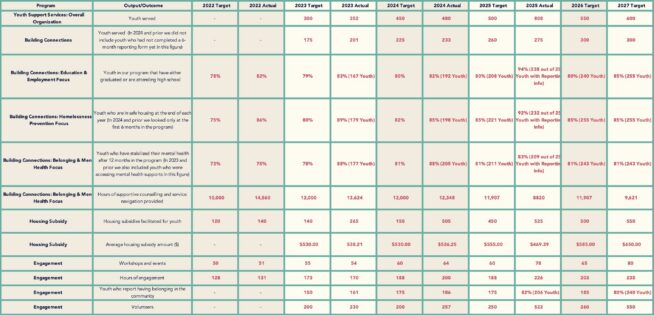
These year-to-year comparisons highlight key outputs and outcomes for youth in our program. Some metrics were not reported in past years or have been updated to best reflect the impact of our programming.

The following outputs and outcomes are shared on this page and across our website. To provide further clarity and transparency, here is a detailed breakdown of how these calculations are made. All outputs and outcomes were compiled in 2026.

Overall Organization

  • Youth Support Services
    • Total Budget:
      • 2024: $2,768,181
      • 2025: $2,592,419
    • Percentage of Overall Organizational Budget:
      • 2024: 100%
      • 2025: 100%
    • Number of youth supported: Every six months, staff report on all unique youth who were active, referred, or discharged in 2025, plus those who attended engagement events or received emergency housing or mental health grants. Duplicates are removed.
      • 2024: 480
      • 2025: 808

Programs 

Within Youth Support Services we have three programs, Building Connections, Housing Subsidy, and Engagement.

  • Our Building Connections Program is our full wrap-around support program, including focus areas such as educational supports, homelessness prevention, and mental health counselling. Outputs and outcomes in this section are completed at six-month intervals and only include the 275 youth in the Building Connections Program, not youth who were only involved in our Housing Subsidy and Engagement Programs.
  • Our Housing Subsidy Program includes youth receiving monthly housing subsidies to ensure they can access safe and stable housing. Outputs and outcomes in this section were made available to the 808 youth supported by our overall Youth Support Services program
  • Our Engagement Program includes workshops, community events, and gatherings open to all youth in and from the child welfare system.
  • Building Connections Program: 
    • Total Budget of Program:
      • 2024: $1,596,655
      • 2025: $1,664,335
    • Percentage of Overall Organizational Budget:
      • 2024: 58%
      • 2025: 64%
    • Number of youth in our Building Connections program supported: Staff report on all unique youth marked active or discharged during 2025, removing duplicates. In 2025, we began including youth in the program who have not yet completed a six-month reporting form.
      • 2024: 233
      • 2025: 275 (252 with Reporting Information)
    • Demographics of Youth in our Building Connections program: Youth complete a Demographic Survey at program intake.
      • Identify as a Person of Colour:
        • 2024: 151
        • 2025: 189
      • Identify as Black:
        • 2024: 97
        • 2025: 119
        • Identify as Indigenous:
          • 2024: 15
          • 2025: 19
        • Identify as 2SLGBTQ+:
          • 2024: 52
          • 2025: 54
        •  Gender
          • Identify as a Man
            • 2024: 66
            • 2025: 71
          • Identify as a Woman
            • 2024: 147
            • 2025: 166
          • Identify as Non-Binary
            • 2024: 14
            • 2025: 14
          • Identify as a Transgender Woman
            • 2024: 4
            • 2025: 1
          • Prefers not to say
            • 2024: 2
            • 2025: 0
    • Building Connections Focus: Education and Employment
      • Youth in the Building Connections program who have either graduated or are attending high school: Includes all youth in our program with a high school diploma and those who are attending school. Some of the youth in our program are high school age which is why “attending” has been added to this statistic. Youth from foster care often take longer to graduate from high school due to disrupted educational pathways from constant moves, exiting the foster care system, and other factors. However, with StepStones’ support they are able to graduate at much higher rates than the general population of youth from foster care (48%).
        • 2024: 192/233
        • 2025: 236/252
    • Building Connections Focus: Homelessness Prevention 
      • Youth who were in safe housing by the end of the year in the Building Connections program: safe housing excludes “couch surfing”, shelters, homes facing eviction, and homelessness. In prior years, this was reported at the six-month mark of their involvement at StepStones.
        • 2024: 198/233
        • 2025: 232/252
    • Building Connections Focus: Belonging & Mental Health 
      • Youth who have stabilized their mental health after 12 months in our program: Stable mental health means no severe symptoms or danger to self/others. For those excluded, we track how many are actively receiving mental health support.
        • 2024: 205/233
        • 2025: 209/252
      • Hours of therapy, counselling and service navigation offered: Total hours of free support, therapy, and counseling, including monthly meetings with StepStones staff and up to 10 therapy sessions per year at a maximum cost of $150 each.
        • 2024: 12,348
        • 2025: 8,820
  • Housing Subsidy Program:
    • Total Budget of Program:
      • 2024: $380,258
      • 2025: $198,614
    • Percentage of Overall Organizational Budget:
      • 2024: 14%
      • 2025: 8%
    • Housing subsidies distributed: Monthly rental subsidies provided to youth in our program based on need. Subsidies are awarded based on criteria and need. For example in 2025, 100% of youth receiving the subsidy do not have the means to pay their rent without it and a maximum of 30% of the total rent is paid by the subsidy, among multiple other criteria.
      • 2024: 505 subsidies, $526.25 average cost per subsidy
      • 2025: 525 subsidies, $469.39 average cost per subsidy
  • Engagement Program: 
    • Total Budget of Program:
      • 2024: $227,722
      • 2025: $223,948
    • Percentage of Overall Organizational Budget:
      • 2024: 8%
      • 2025: 9%
    • Workshops and events facilitated: The total number of workshops, community events, and gatherings facilitated by StepStones staff for youth.
      • 2024: 64
      • 2025: 78
    • Hours of Engagement: The total number of hours of workshops, community events, and gatherings facilitated by StepStones staff for youth.
      • 2024: 200
      • 2025: 226
    • Youth who report having belonging in the community: The total number of youth surveyed who answered this question ‘Yes’. This question is only included on our intensive reporting form at this time so is limited to youth also in our Building Connections Program.
      • 2024: 186/233
      • 2025: 206/252
    • Volunteers assisting with programs: All unique volunteer engagements are tracked using our Volunteer Hours Form and Volunteer Placement Form.
      • 2024: 257
      • 2025: 522
  • Remaining Costs: These are the remaining costs of our budget that include administrative and indirect program expenses. 
    • Total Budget:
      • 2024: $563,545
      • 2025: $505,522
    • Percentage of Overall Organizational Budget:
      • 2024: 20%
      • 2025: 19%